
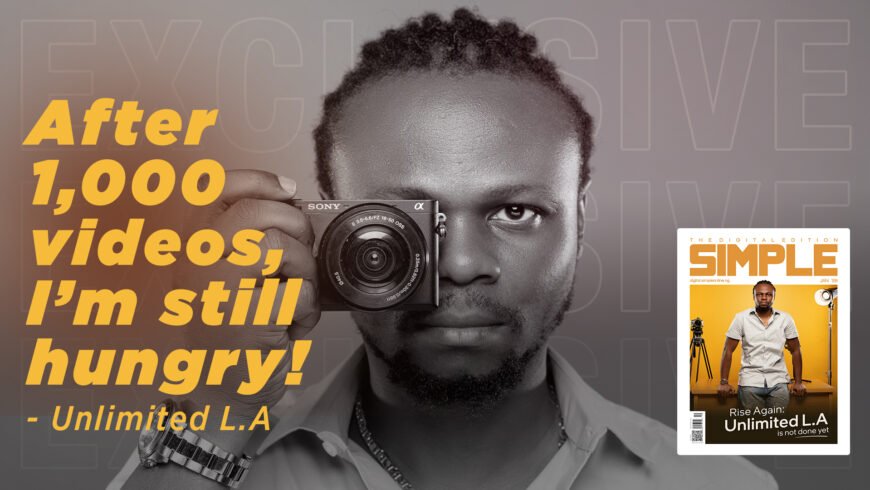
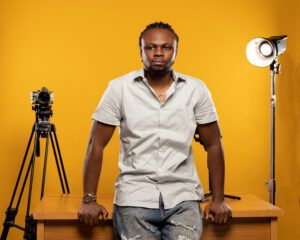
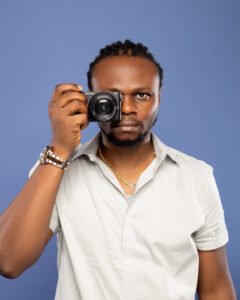
For over two decades, Unlimited LA has been one of the unseen architects of Afrobeats’ global rise—shaping the images that traveled farther than the songs themselves. From Wizkid to Olamide, from viral dance moments to era-defining visuals, his lens has helped define what African pop culture looks like to the world.
But after directing over 1,000 music videos, the man born Buari Olalekan Oluwasegun isn’t chasing nostalgia, or retirement. Instead, he’s transcending his frame.
With Rise Again, his debut Africa Magic Original, Unlimited LA turns the language of music videos into long-form storytelling, fusing dance, Afrobeats, love and survival into a six-part series about resilience and redemption. Featuring a cast that blends dance royalty, reality TV stars and pop culture heavyweights, the project feels both familiar and entirely new, much like its creator.
In this conversation with SIMPLE Magazine, Unlimited LA opens up about refusing to see film as a “shift,” selling personal property to finish production, why dancers’ stories deserve center stage, and why sometimes the only way forward is to ignore every “no” you hear.

You’ve mentioned directing over 1,000 music videos before shifting toward film and television. What triggered the moment when you decided, “I’m ready for the next challenge”?
I wouldn’t say what triggered cause even as a music video director, as lot of people know me I’m also a cinematographer and I have done couple of projects be it documentaries, films, short films, television commercial but this particular film is the first film I get to produce and direct myself. I wont call it a shift but just another project for me cause when I saw the story I was interested in the story so I decided to produce and direct it my self. It a dance film and Afrobeats love story so the dance aspect of it is Afrobeats so when I saw the story I was very interested because it has to do with dance and its Afrobeats.
The series follows a gifted dancer’s journey of resilience, betrayal and redemption. How much of that story draws on real experiences you’ve seen worked with or confronted personally?
It happen all the time cause I have worked with so many dancer like 100 of dancers and tell this is actually there story cause over the years from 2010 to presently have been working with different generations of dancers and categories of dancers and this story is their story.
You’ve spoken about the many “no’s” you encountered while building your new path. Can you tell us about one “no” that became a key turning point in production or creative direction?
I can’t say one no particularly because it was lot of no’s, I mean I’m not shooting this film as a novice, I’m well experience and I’m a skepticism type of person, so I already expect no when I ask you for something. The no’s that I got I was actually expecting those no’s but I don’t like to take no for an answer, when you tell me no is when I feel I need to work harder to make sure I execute the particular project, so the no’s I got propped do more to execute this project.
In transitioning from short-form music videos to a longer narrative format, how did your approach to character development, pacing and visual storytelling evolve?
Like I said have been doing this for over 15 years, short form of storytelling is music video, so to me it is just like doing music video everyday until you get to like 2 hours of it. It wasn’t anything different or special to me just like continuous of what have always been doing.
Nigeria and broader Africa is rapidly becoming a storytelling hub for film and streaming. How do you see Rise Again positioning itself within this evolving landscape locally and globally?
I see rise again as first of its kind so I just know from now on the next couple of things you are going to be seen on those platforms are things that have been inspired by rise again.
Can you walk us through the selection of the cast for rise again?
I started working on the film 5 years ago, the first set of people I spoke with, I spoke with Poco Lee, he was supposed to be the lead actor but he didn’t come through, then Tiwa Savage was supposed to be on the film but she was working on her project and also Larry Gaga was supposed to be on it but because of funding and timing I didn’t get to work with them but the rest of the guys it was just phone call all the way.
“I don’t like to take no for an answer, when you tell me no is when I feel I need to work harder.”
With the cast including dance icon Kaffy, reality stars and other high-profile personalities, how did you strike a balance between star power and narrative integrity?
It wasn’t only Kaffy on the project, we have Koko by Khloe, Liquorose, Hermes, Eloswaq, Mr P, Dotun, and other stars. What made it easy for me was this entire people I mentioned were all my friends, we have working relationship and we been around for the longest- it wasn’t hard for me we were like a big family.
On a creative level, If you could go back and shoot one music-video-style element into one of the episodes (purely for fun), what would you bring and why?
It will be the last episode, episode six with the final dance battle cause we had a whole lots of challenges that day, I was so helpless that the characters were the ones encouraging me because we are all drained.
At any point during conception or production, did you consider or evaluate the audience perception because the project is something new to the Nigerian terrain?
I wouldn’t say it is new because we all watch music videos all the time, it’s just like watching a long form of music video with the story line in it, a music video last 3min to 4 min but this is lasting like 2 hours, it’s just a longer format of a music video.
What were the biggest production or logistical challenges you faced on rise again and how did you overcome them?
Quick story; I really set out to start filming at a particular date, everything is done planned, a week before production fuel price move from 500 all the way to 1,000 and that cause a whole lot of trouble, challenges in terms of logistics and everything- you know the way things go in Nigeria once there is a increase in fuel everything automatically increases so I ended up paying more for welfare, logistics and hotel because I was already in it and I couldn’t stop, I ran out of money I have to sell some of my properties to make sure I have to put through. I think that is the fuel increase we couldn’t even buy for 1,000 cause some petrol station was not opened so I remember a night I brought fuel for 1,500 per liter and I bought over 300 liters that really cost me but just because I am experienced so I know I cant stop, stopping means I have to spend more later on so I didn’t have a choice than to sell some my properties to make sure the production go smoothly.
How do you create these videos? Do you get inspiration after seeing the script or before the script?
For me I’m a creative, I write some of these things and also as a creative I’m also an executive, as I’m thinking of creating this I’m also thinking of funding at the same time. For me it’s just another day at the office.
“I don’t select project as long as you can afford to pay me.”
Outside of the serious stuff: what is one habit or ritual you have on-set that helps you stay inspired or keeps the mood light when things get heavy?
On set I’m always picking on people, we crack little jokes around- if you’re familiar with my set you will understand.
Who are some of the most interesting people you have worked with?
Interesting people I have worked with, I will say Wizkid- he’s one funny guy, he cracks me up anytime we meet on set. I love working with Mr. P, he’s very creative and he knows what he want. Olamide is another person I love working too, I think I enjoyed working with everyone I have worked with it.
Music videos of the early 2000s always had storytelling compared to what we have now. What is your take on that?
I will say nowadays is more of montage but back in the days is storyline because of the music, most music video director draw inspiration from the song itself, so if you have a song talking about random things, you will definitely get random video. I will say it’s the music, there’s nothing wrong with the visuals.
Looking at the popularity of Afrobeats today: do you feel music video directors get the accolades that they deserve?
Because we are the last guys on the line of representation of Afrobeats, it goes from the artiste to the producer to the record label to the distribution companies all the way to the individuals but I don’t think we are getting recognition as much as we should but at the end of the day it’s through our work the outer world is using to see the image of the Afrobeats. We aren’t been recognized enough but we are in there.
What was the general feel of the production?
I had so many crewmembers; they are more than 70 people everyday for 21days. Even on my music video we can be more people in different department but on this film set we had everybody everyday for 21days, for me the experience was just having lots of people for 21days.
“What works for me I don’t think it can work for any upcoming and aspiring videographer.”

Looking ahead: by the time Rise Again finishes its run, how do you want audiences to feel, think or act differently than when they started?
For the film, I want the audience to feel like this is possible and we did it, for the storyline, I want every dancer out there to be hopeful- keep doing what you’re doing and you will breakthrough.
Let’s look at your typical 24hrs while working, what does it look like?
I love planning; I can spend a lot of time planning so that on the day of the shoot I don’t have any issue but at the end of the day something will still pop out. Just because I’m very experienced in production, there’s no department that’s strange to me; so I always make sure I go through all the departments from the set to stylist to make-up, camera gear check, light and all.
What influences your selection of projects? What determines if you will accept work on a project or not?
I don’t think I have ever selected any project, in my years of experience I can say categorically that there’s no such thing as terrible music, I don’t select project as long as you can afford to pay me.
What would be your advice to anyone aspiring to go into your line of work?
It’s hard because I don’t even know the advice to give anyone cause times have changed, what works for me I don’t think it can work for any upcoming and aspiring videographer or cinematographer.
Finally, if you weren’t making videos or series, what would you be doing, and how does that alternate version of yourself influence the version the audience sees on screen?
I would probably be a tech bro or engineer, cause I’m very good with gadgets and computers.
Watch full interview on YouTube:
Production Credit:
Interviewed by Tola Adebayo
Photographed by Dare Yomi
Videographed by Fisayo Ebiniyi
Creative Director: Rayo Kasali
Executive Producer: Adedamola Edun