
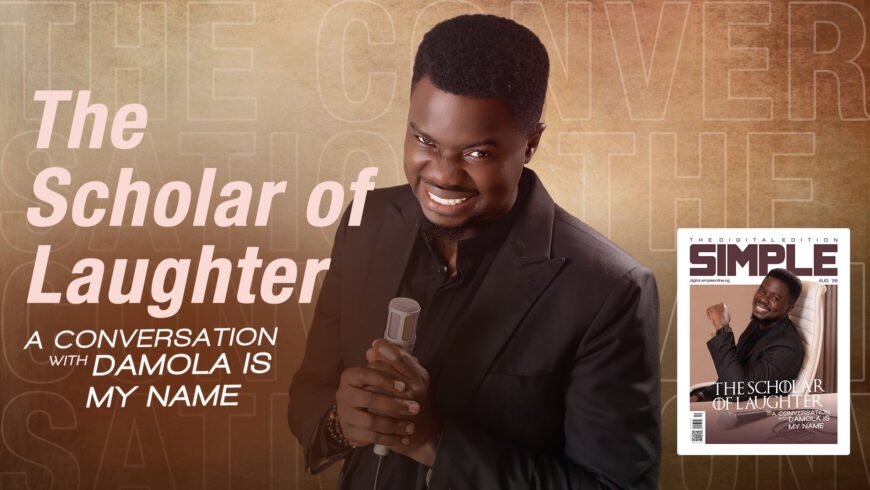
There is a lot going on in Damola Adegboye’s professional life. He is a university lecturer with a First Class degree in Political Science, a Master’s degree from the University of Ibadan and a Ph.D from Lagos State University. He is also a Master of Ceremonies and a stand-up comedian, known professionally as Damola Is My Name.
At first glance, these may seem like very different worlds. But sit with Damola for a while and the connection becomes clearer. His work, whether in a classroom, at a corporate event or on a comedy stage, is ultimately about people. Understanding them, speaking to them and knowing how to hold their attention.
That ability to understand a room is something he has developed over the years. For Damola, being an MC is not simply about picking up a microphone and keeping an event moving. It requires paying attention to the mood of the room and knowing that an audience can change as an event progresses. A room that starts quietly may become lively later. An audience that begins full of energy may suddenly become subdued. The person holding the microphone has to notice those changes and respond accordingly. He learnt some of this through experience.
His journey into comedy was not exactly planned either. He had always been the talkative one and the person who could make people laugh. Then a school friend asked him to anchor an event. One opportunity led to another, moving from small gatherings to bigger stages. What began as something he did for fun gradually became a career.
By the time he graduated from university, Damola had begun to see the possibilities more clearly. Around 2012, he decided to pursue the career more deliberately.
More than a decade later, he is still learning, but he is also looking back and helping others find their way. His recent masterclass brought together people who wanted to learn from his experience, and another edition is already in view. For him, mentorship is important because it can shorten the journey. Someone who has already made the mistakes, learnt the lessons and understood the business can help another person avoid taking the longest route.
That emphasis on learning runs through much of his thinking about the industry. He is equally comfortable talking about the rise of skit makers, the importance of stand-up comedy, the need to build an online presence and the responsibility entertainers have to understand their strengths.
The comedian in Damola is easy to spot. The academic is not far behind. But perhaps the most important part of his story is the person who has spent years learning how to understand an audience.
Because whether he is teaching a class, hosting a corporate event or telling a joke, Damola knows one thing very well: before you can make a room laugh, you have to know what is happening in the room.
In this conversation with Damola Is My Name, he speaks on comedy, corporate crowds, mentorship, clean humour and the business of making people laugh.
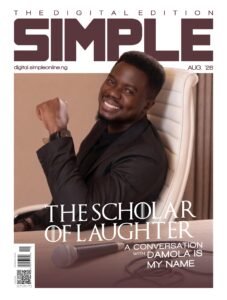
SIMPLE: How do you maintain neutrality when MCing an event or performing comedy? Because we all have biases. How do you ensure yours do not affect your work?
DAMOLA: This is where professionalism comes in. You must, as much as possible, ensure a value-free approach to all your work, particularly when in your professional capacity. For me, I completely detach myself from any form of bias. I perform my duties as they should be done, adhering to professional ethics without any form of affinity. The essence of my approach is ensuring everyone feels comfortable. I lead with this consciousness, and it guides my conduct both publicly and privately, especially when on stage. I endeavour to avoid making anyone feel uncomfortable through my words or actions, which is essentially who I am.
SIMPLE: It is also obvious in your comedic line that you prefer not to make people uncomfortable with your jokes.
DAMOLA: For me, the purpose of comedy is to make people happy and laugh, not to make them feel uncomfortable. Even when we touch on topics that may cause discomfort, we do so in a way that is enjoyable. The goal of comedy is for the audience to relax, laugh, and, even if they become the centre of the joke, it should be in a way that elicits laughter.
SIMPLE: How did life lead you to this path?
DAMOLA: I have always been the talkative one in a room and the person who made people laugh. One day, a school friend approached me and asked if I could anchor an event. Before I knew it, I was from one backyard to the sitting room to the compound and finally to the stage. We are grateful for the opportunities that have come my way. It was not something I had considered when I entered university, but I found myself enjoying the platform because I felt I could speak. Initially, I did it for fun, not realising I was building my capacity over the years.
SIMPLE: Was there a particular moment when you consciously decided to take this path?
DAMOLA: I made up my mind immediately after graduating from university, having met my mentor and realising it was something I was very comfortable with. I decided this was the path I would like to explore. Around 2012 was when I made this decision.
SIMPLE: As a professional in this field, what are some of the most common mistakes comedians make when hosting corporate events or corporate MCs make when attempting to deliver humour?
DAMOLA: Many MCs assume all events are the same and enter with the same energy. However, each event has its own tone, language and atmosphere. It is essential to understand the room before speaking. A key aspect of anchoring events is to comprehend the setting and the mood of the audience. As a comedian, you should not enter the room and immediately deliver jokes, as some may not be receptive. You are in a formal setting, such as a corporate event, and your first priority should be ensuring everyone is seated and behaving appropriately. You must adapt to the audience’s energy. While we all make mistakes and strive to correct them, understanding the room and knowing the appropriate actions will significantly influence your performance at that event.
SIMPLE: Have there been instances where you completely misread the room?
DAMOLA: Yes, years ago. I remember Sako took me to a corporate event somewhere in Victoria Island about ten years ago, and I just walked up to the stage and started cracking jokes. People had not even arrived like that. There were only a few people in the room, and I just went into comedy mode. It was funny, but it was not contextually right. Over the years, I have learnt not to make such mistakes again. Also, that is why mentorship is very important. There were jokes I used to do then that he had to correct me on, where and when to do certain jokes, and the type of jokes not to do at all because they were not appropriate. Over the years, I have learnt and been able to develop and build capacity in that light.
“Before you can make a room laugh, you need to understand the room.”

SIMPLE: Mentorship seems to have played a significant role in your career. What did it give you?
DAMOLA: Mentorship has a way of shrinking the distance. If you are lucky to have a mentor who is willing to go with you and put you through what they have passed through, you do not have to go that route anymore. They help you to shorten your journey to success. The beauty of mentorship is that they can guide you. They have walked through it, so you do not have to do the full journey again, making the journey simpler. That is what mentorship, to a very large extent, did for me. It shaped me, helped me grow, shaped my thinking, my mind, the way I present myself, the way I think about the job, the way I think about money and the way I think about the business of the job. Mentorship, to a very large extent, is a very important aspect of any career path if you really want to go far, but you also have to build the necessary character to be a good mentee. Inasmuch as we have some mentors that could be tormentors, we also have mentees that are not progressive in their minds. They just want to get things without character, and things do not work like that. Being a mentee without having the right character will be counterproductive.
SIMPLE: On the recent masterclass you held, what gap in the industry were you trying to fill, and what surprised you most about facilitating the conversation?
DAMOLA: One of the things that surprised me was seeing a lot of people in the room that I felt would not show up, but they did because of the desire for knowledge, and that is very important. The idea I had about facilitating this conversation was to share from the little that I have garnered over the years. A lot of people reach out to me and say, ‘I want you to mentor me,’ so I saw that as an opportunity to bring everybody together so they could ask all the questions that they had in mind. We are going to have another edition later this year too. I see this as an opportunity to help others grow, contribute my quota to the development of my industry, and also create an avenue for people who feel they can do what I do in their own expressions. I saw that as an opportunity to help shape their minds and craft.
SIMPLE: What is your take on skit makers coming to events as stand-up comedians?
DAMOLA: Well, if you are a skit maker and you can do stand-up, then it is absolutely correct. Why not? Everybody is happy to listen to you. I know a number of skit makers that do stand-up, and they do it very well, but the fact that you are a skit maker does not make you a stand-up comedian. So you need to understand your strengths and weaknesses so you do not go on stage and mess it up. We have good skit makers that are good comedians. I have seen Sabinus do stand-up comedy, and it was good, and a number of them. Do not say because you have a very strong sense of humour with skits you are automatically a stand-up comedian. They are two different things. Your ability to act out jokes is very different from telling them on stage. If you can synchronise both, that is good, but if you cannot, it is better to stick to your area of strength. Personally, I do not have a problem with it. It is a good environment, and we can all co-exist.
SIMPLE: How would you say your style of comedy differs?
DAMOLA: I do relatable, family-friendly jokes. Most of the things that I say are things you can actually relate to. You might have experienced it, or someone around you might have experienced it, or someone close to you must have told you about something related to that matter. Those are the kind of jokes that I do. Most of the time, I do a lot of comparative analysis in my jokes. I talk about this and that, what is and what it is supposed to be. I also do a chronological overview of issues and then come up with a punchline eventually. That is my style, and I have grown with it over the years. I also do a bit of storytelling.
SIMPLE: When you walk into a room or event, how long does it take you to read your audience?
DAMOLA: Sometimes it takes seconds, sometimes minutes. As the event continues, you also need to understand the sequencing and the behaviour of the audience. Anchoring events is not just about grabbing the microphone, as I will always say. It is about managing people and situations. For example, maybe the event started off in a very happy mood, very energetic, but possibly at some point something happened at the event that brought down the mood. You need to understand that how we started is not where we are. There are also times the event starts on a very sober note and eventually picks up, so you need to understand it and then flow with the height as it happens so you are not out of line and not out of context. That is something I have tried to learn over time.
SIMPLE: Have you ever landed a joke and it did not get the desired effect? How do you recover from such?
DAMOLA: You just continue or in extreme cases, walk off the stage. But in all seriousness, you just continue with the next one and the next one.
“Mentorship has a way of shrinking the distance.” “That small stage is big enough for you to build a lot of capacity.”

SIMPLE: Can you walk us through one event where you have had to switch from MC to comedian?
DAMOLA: That happens a lot. If the brief is that you are coming in as a Master of Ceremonies and stand-up comedian, you have to manage both. There was an event where I was not necessarily there as a stand-up comedian, but as a corporate MC. During the course of the event, the light went off. The whole sound and light system tripped off, and it was a corporate event, so I had to vocalise manually. The only thing that could happen there was stand-up comedy, and immediately I switched, with my bare voice. I had to do that for a good number of minutes until light was restored because nothing could have really happened without light at that particular event.
SIMPLE: Damola Live is officially happening. Walk us through it. What is the vision, and what are you most excited for people to experience?
DAMOLA: I am very excited because this is the second comedy special I am having. I am bringing people out to have a good time, a good time by every letter of the sentence, from the entrance to the show itself. A good time all round, an amazing and excellent experience. I am going to be doing comedy. I have some other colleagues of mine too that will be doing comedy, and there is going to be live music too. I am bringing people into a room full of positive energy, good people, good jokes, good music, a good environment, and everything is going to be maximally on point. It is a family-friendly show where you can come with your wife and children, your staff, and everybody is happy. Even if it is just you needing somewhere to relax on a Sunday evening, I am bringing a beautiful experience to people. That is what I want to achieve.
SIMPLE: Where do you think Nigerian comedy is headed, particularly with the rise of skit makers and social media?
DAMOLA: I need people to really understand that there are various expressions of entertainment, and all these expressions appeal to people in different ways. Stand-up comedy cannot necessarily replace skit makers, and skit makers too cannot replace stand-up. They are two different things, and people need to realise and understand that none is in competition with the other. Skit making is a global phenomenon; stand-up comedy is an internationalised market. There are stand-up comedy bars and studios across the world. It is not just restricted to Nigeria. People enter comedy clubs just to have a drink and enjoy the comedy show, the same way people enter a place where they are singing. There is a stand-up comedian on standby to make you laugh; you have your drink, your popcorn or food, and you are enjoying stand-up comedy at the same time. Skit making and stand-up comedy independently coexist. I love stand-up comedy. I go to a comedy club and sit down and laugh, and there are different comedy clubs active on different days of the week in Lagos. And if the mood is to laugh at skits, there are pages on Instagram that you can watch. If you want to do the two, you do not have to leave your house. There are comedy specials all over the internet, Nigerian, American, British, South African, whichever one that you feel like enjoying, just enjoy. And if you are looking for skits, there are so many. The most important thing is that entertainment is achieved. You feel entertained, the person entertaining you gets paid for what he is doing, and everybody is happy.
SIMPLE: Back to mentorship. Who are some of the people you learnt from, watched and tried to emulate on your way up?
DAMOLA: Yes, Sako is my mentor, but then you also have a lot of role models. There is a difference between mentorship and role models. There are people you just admire. Starting off, I did not even know Sako when I started off in school. The ones I knew and really admired were the likes of Basketmouth and Koffi. There was a soap opera we used to watch on TV that had most of these people at the time, and I really admired them. Gbenga Adeyinka is another person; Alibaba, T.A, Holy Malam, Julius Agu, Owen G, AY, Omobaba, and a few others we used to watch and admire. To a very large extent, they shaped how we used to do things. I remember when I just started, I used to watch Basketmouth then and do some of his jokes and be happy. As I continued to grow, we started developing ours. These people have shaped our orientation over the years. And as a Master of Ceremonies, we watched so many people. IK Osakioduwa, Alariwo used to be a Master of Ceremonies too.
All these people mentioned inspired us and continue to inspire us. I see all my senior colleagues as role models in specific areas of this job, and one thing or the other can be learnt from all of them.
SIMPLE: What should your fans and followers look forward to from you?
DAMOLA: The Damola Live and the Masterclass 2.0 are what I have for them. These two are wholesome events.
“The purpose of comedy is to make people happy and laugh, not to make them feel uncomfortable.”

SIMPLE: How do you manage to keep a balance between family time and work, especially since your work a lot of times is on weekends?
DAMOLA: My job is quite time-consuming. It requires my presence, so I try to ensure that every opportunity or freedom that I have to spend time with my family, I make sure I do it extensively, generously. They understand when they do not see me that I have gone to work, but when they see me, I maximise that moment and ensure that we have our family moment, and we do it to a very large extent.
SIMPLE: If you could go back to the young graduate then, knowing the path you were about to follow, what advice would you give for the journey ahead?
DAMOLA: To enhance your online presence, as you are giving yourself physical attention, ensure you also cultivate a strong online profile. Initially, I did not prioritise this aspect of my career, but as the digital landscape has evolved, I have recognised its importance. While online presence was not a significant concern when I began my career, it is now crucial for alignment with current trends.
SIMPLE: For the younger Damola’s in the university looking to emulate your rise, what advice do you have for them?
DAMOLA: Just continue to build capacity. That small stage is big enough for you to build a lot of capacity. Develop your use of words, your use of language, understand how to relate with people, build character. That small event is not small; it is just one of the building blocks towards where you are going. So do not despise it; enjoy the process. Do not let money be the central theme for now. Let it be a motivator on the side but not necessarily the central focus so you do not lose out on opportunities to express yourself. You need the platform to express yourself, be seen, be heard, and one of the ways to achieve that is making yourself available to do the events that you can do at this level. So by the time you finish school, you are a full package, maybe a raw talent still, but a very nutritious one that, by the time you are processed to become a finished product, you are a wholesome package.
SIMPLE: What do you imagine the next decade will look like?
DAMOLA: It is going to be bigger, better. There are so many newer comedians now. It shows that the stand-up comedy culture is being socialised from generation to generation, and there are different expressions and approaches to it, which is beautiful. When you come to my comedy show, you will see some younger comedians that you have never seen before, some contemporary ones that you might have seen, and you will see some of the senior colleagues too there. It is a wholesome thing. The Nigerian comedy industry is evolving, getting better. There are newer approaches to it, one of which is skit making.
Watch full interview on YouTube: